
Clinical Trial Intelligence
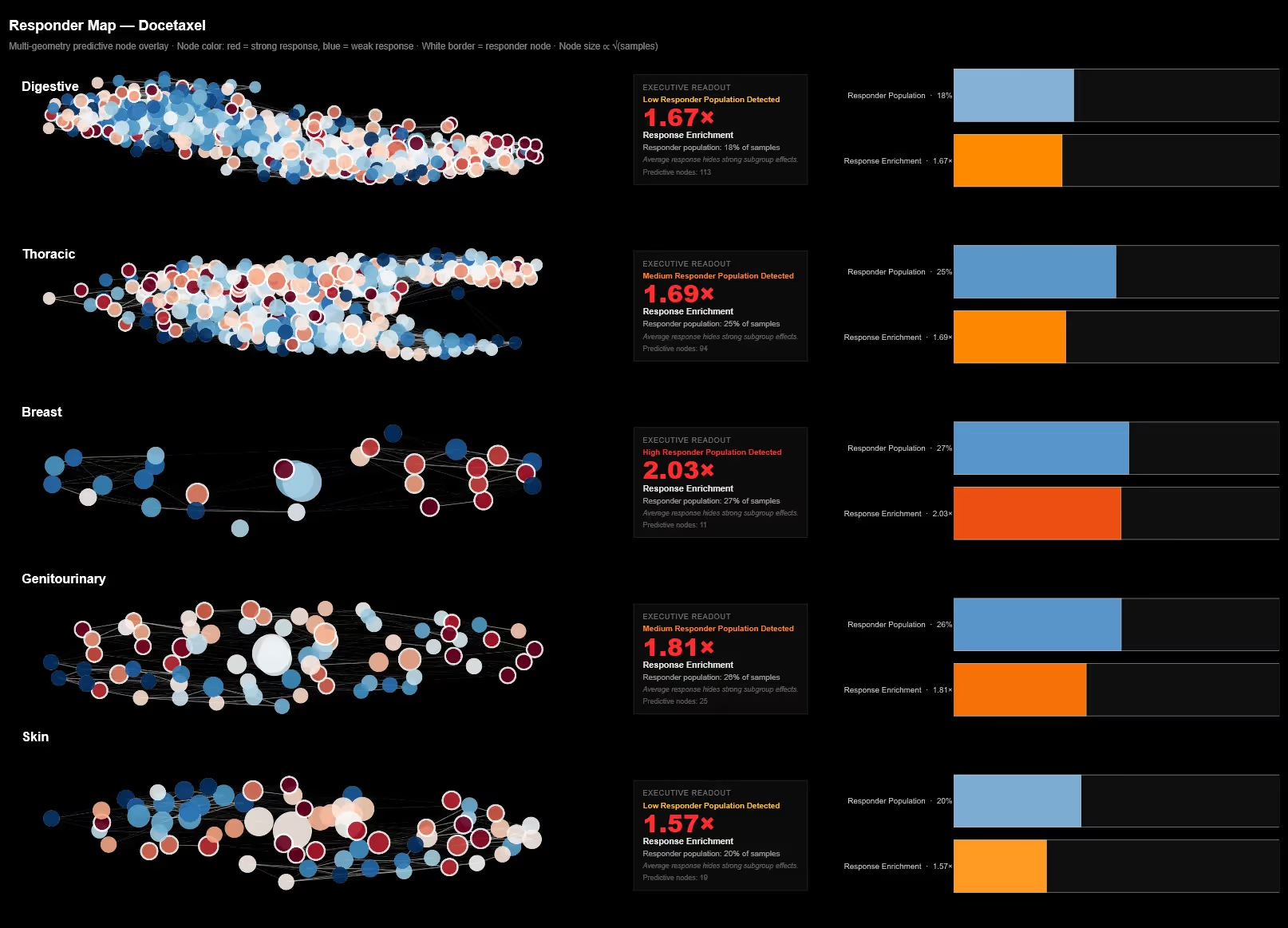
Responder Maps available - click for demo
Subscribe to our newsletter
Subscribe to keep updated on our products and new releases, as well as free Responder Maps drug integrations
The Responder Lab was started by University Professors in order
to explore how geometrical learning could be utilized to find
patient responders in clinical trial and treatment data, in order
to get more trials passed and bring the right drug to the right patient.
Wojciech Chachólski
Co-founder and CTO
Professor at the Mathematics Department, Royal Institute of Technology, KTH and head of the Topological Data Analysis Group (TDA) at KTH. Prof. Chachólski’s research has been supported by the Swedish Research Counsel, Wallenberg AI autonomous Systems (WASP), and Digital Futures KTH.
Ryan Ramanujam
Co-founder and CEO
Associate Professor at the Karolinska Institute. Dr. Ramanujam has a multidisciplinary background comprising advanced degrees in science, engineering and business, including a Ph.D. in Medical Science from the Karolinska Institute.
Sandra Di Rocco
CSO
Dean of the School of Engineering Sciences at Royal Institute of Technology, KTH. Professor Di Rocco heads a research group at the Mathematics Department, Royal Institute of Technology, KTH.
We currently we offer analysis of clinical trials as well as pre-clinical compounds in the following ways:
1) Responder Architecture Certificate - Analyzes a single compound against our structural geometry of oncology drug response. Imputes response based on drug SMILES and optional MOA, and provides a detailed report on responder population, efficacy enrichment, sample size reduction calculations, and biomarkers of response. Does not require data from drug sponsor. See example report here.
2) Responder Compass - Geared toward prioritization of early-stage compounds, analyzes a single compound against our structural geometry of oncology drug response to give outcomes for up to 20 different cancer types. Provides clear data toward which indications hold strong promise by reporting projected response, responder populations, and biomarkers likely to be enriched among responders.
3) Trial Enrichment Strategy - Analysis of a current trial, usually Phase 2 or 3, using sponsor's data such as tumor gene expression and outcomes. Gives the gold standard of response, characterization of subgroups of response, out of sample testing of stability, and biomarkers of response. Full regulatory grade information provided. See our latest papers for details
Check our product page for more details!
We are currently focusing only on cancer for clinical trial prediction and subgrouping, as well as determining biomarkers of response and repositioning. The reasons for this are that our core structural geometry platform Responder Atlas is built on gene-expression data from public data. This allows us to utilize our geometrical learning technology, and extrapolate to cases where the same data is not available. Oncology research has the most vast public repositories of omics data, patient cell-line and treatment experiments, and this richness of data is difficult to duplicate in other types of disorders.
Nevertheless, we may expand to autoimmune and inflammatory disorders, as well as neurological and neurodegenerative disorders in the future.
Yes! A core aspect of our technology is to use geometry to create backbones across multiple data types. We are able to impute new drugs based on SMILES/MOA similarities, even when no experimental data exists. This means that in principle, we can analyze any molecules possible.
Our methodology achieves a correlation coefficient of 0.54 for response imputation across dozens of cancer types, which allows for responder predictions with a reasonable degree of projected accuracy to guide clinical programs.
However, a current limitation is in immunotherapy, for which we are working on methods to integrate into our current platform.
There are many startups using AI to try to do "AI drug discovery", with various methods. AI is great for problems where there is a lot of training data and an LLM or machine can learn those patterns. When data is limited, say a hundred samples and 200,000 genes, other methods are needed.
Our geometrical learning technology transforms data into multiple geometries, while preserving and compressing relationships between the data. We then apply machine learning models to create unbiased estimates of prediction accuracy, and then find biomarkers when valuable.
This allows us to find "gold standard" of responders in time to event analysis, and predict these with over 80% out of sample accuracy - this is not possible with other techniques!
See our latest paper for details: https://www.medrxiv.org/content/10.1101/2024.07.01.24309803v3
World leading technology to determine subgroups of response in clinical trials and treatment data.
Led by Professors with decades of research in mathematics, genetics, omics, machine learning and statistics & epidemiology.
Tools to improve chances of passing clinical trials, identify biomarkers of response (companion diagnostics), and getting the right drugs to the right patients.
Mail : info@responderlab.com
Products
Technology
Research
About Us
Contact Us
Copyright ©️ 2026 The Responder Lab